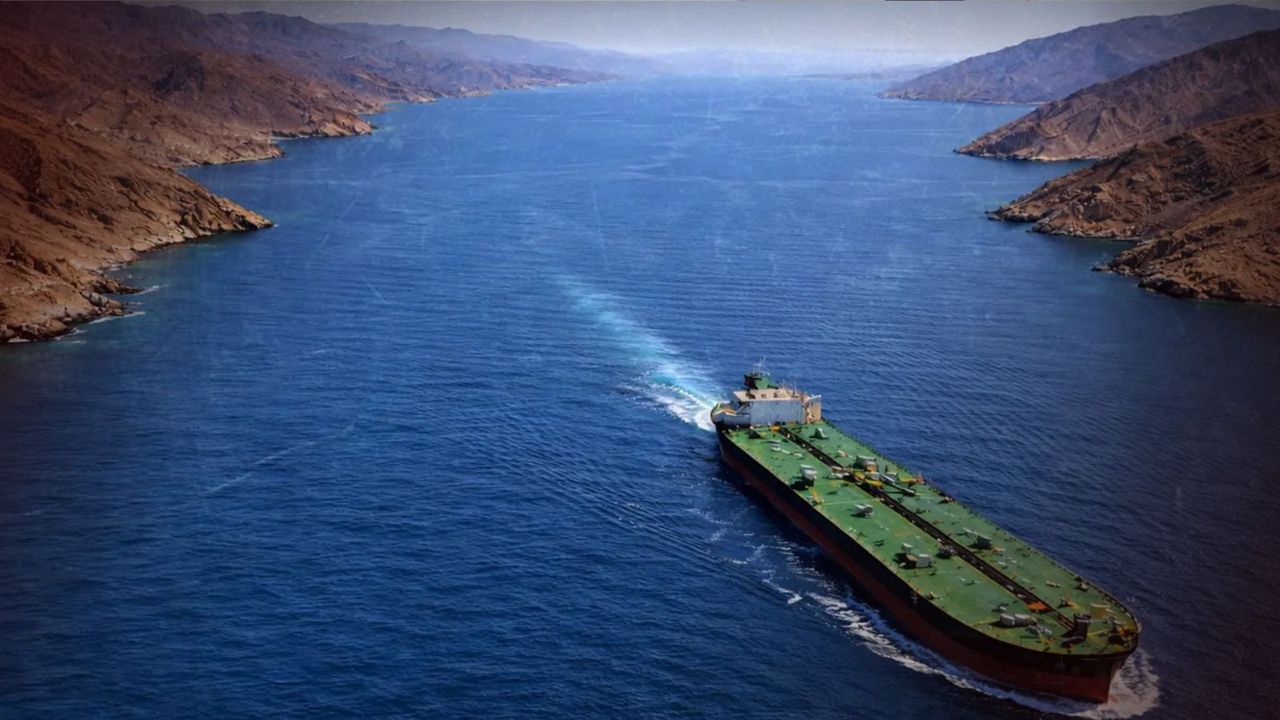
A strip of water no wider than 39 kilometers at its narrowest point carries the economic lifeblood of the modern world.
The Chokepoint the World Cannot Afford to Lose
The Strait of Hormuz, linking the Persian Gulf to the Gulf of Oman, channels roughly 20 million barrels of oil per day, around one-fifth of global consumption. According to the U.S. Energy Information Administration, it accounted for more than a quarter of global seaborne oil trade in 2024, with nearly all of Qatar’s liquefied natural gas exports passing through the same corridor. There is no viable alternative at comparable scale.
This is not merely a waterway. It is a pressure valve for the global energy system. For decades, the Strait operated under a fragile but functional equilibrium: Iran threatened, the West maneuvered, and tankers sailed. That equilibrium collapsed on February 28, 2026, when U.S. and Israeli forces launched a long-prepared military campaign, one that, it is now clear, was never intended to be brief.
Within days, vessel traffic fell by 70 percent. By March 11, it had dropped by 90 percent, with just two outbound crossings recorded and none inbound. The Strait did not slow, it effectively stopped. What is unfolding is not just a military confrontation. It is a real-time demonstration of how a phased campaign of force can trigger a global economic shock, one that appears less incidental than engineered.
The Architecture of Operation Epic Fury
To understand why the Strait of Hormuz remains closed, one must first understand that Operation Epic Fury was never conceived as a single decisive strike. It was designed as a phased campaign - methodical, cumulative, and deliberately sequenced - where each objective unlocks the next.
As outlined by the White House, the campaign’s goals were explicit: first, dismantle Iran’s ballistic missile stockpiles, launch systems, and defense industrial base; second, neutralize its navy; third, permanently eliminate its nuclear weapons capability. A fourth objective, regime transformation, was framed not as an operational task, but as the intended strategic outcome.
The opening phase, executed within the first 48 hours, was a standoff suppression campaign of extraordinary scale. More than 900 strikes were launched in the first 12 hours alone. Over 160 Tomahawk cruise missiles destroyed command nodes and air defense systems. B-52 Stratofortresses operating from Diego Garcia fired long-range cruise missiles beyond Iranian radar coverage, while B-2 Spirit stealth bombers flew directly from Missouri to deliver bunker-busting ordnance against hardened underground facilities. F-35C Lightning IIs penetrated defended airspace with precision strikes, while carrier-based Super Hornets maintained air cover.
The result was immediate and decisive. Among those killed in the opening wave was Iran’s Supreme Leader, Ali Khamenei. Within 24 hours, large portions of Iran’s integrated air defense system had been critically degraded.
Phase two began on March 4, when General Dan Caine announced a “munitions transition”, a shift from long-range standoff weapons to close-range precision strikes conducted within Iranian airspace. The transition was not only tactical but economic. The first 100 hours of operations cost an estimated $3.7 billion, with individual Tomahawk missiles priced at $3.6 million. By contrast, JDAM kits, used to convert unguided bombs into precision-guided munitions, cost roughly $80,000.
With Iranian air defenses degraded and coalition forces achieving growing air superiority, even MQ-9 Reaper drones began operating in daylight over Iranian territory. The shift marked a clear inflection point: the suppression phase had succeeded, and the campaign had entered a sustained destruction phase.
By day ten, according to analysis from the Hudson Institute, U.S. forces had struck approximately 5,000 targets, up sharply from 3,000 in the first week. Iran’s missile and drone output fell between 70 and 85 percent, driven by systematic targeting of transporter-erector-launchers, the mobile platforms essential to sustaining missile operations. Daily launches dropped from roughly 350 at the outset to around 50 within a week. The kill chain was not fully broken, but it was being steadily dismantled.
In parallel, the naval campaign unfolded with equal precision. Iranian surface and subsurface assets were rapidly neutralized. Among the losses was the frigate IRIS Dena, sunk by a U.S. submarine south of Sri Lanka, the first such torpedo strike on an enemy warship since 1945. By March 10, more than 60 Iranian vessels had been engaged, including minelayers, corvettes, and submarines. In conventional terms, Iran’s navy had ceased to function as an effective force. And yet, the decisive challenge emerged not from what remained of Iran’s navy but from what it left behind. Naval mines.
By mid-March, intelligence confirmed that Iran had begun mining the Strait. The initial deployment was limited, only a few dozen mines, but the strategic effect was immediate. Iran retains an estimated 5,000 to 6,000 mines, along with the majority of its small boats and minelaying platforms. Crucially, between 80 and 90 percent of these assets survived the March 10 strikes. At the same time, the United States faces a structural limitation. The U.S. Navy decommissioned its dedicated Persian Gulf minesweepers in September 2025, replacing them with littoral combat ships whose mine-countermeasure capabilities are secondary rather than specialized.
The result is a stark asymmetry: a low-cost, persistent threat confronting a diminished and time-intensive response capability.
“We are at a point of munitions transition… shifting from stand-off munitions at range to stand-in precision strikes overhead Iran,” General Caine stated on March 4.
What he did not say, but what events have made clear. is that the campaign’s most consequential battlefield is no longer in the air or at sea. It is in the narrow, mined waters of the Strait itself.
Ships Stranded, Routes Redrawn
The phased military campaign has triggered a parallel commercial collapse, just as deliberate in its sequencing, and just as far-reaching in its effects. In the days following February 28, major shipping companies began suspending transits through the Strait of Hormuz. By March 5, war risk insurers had withdrawn coverage for the Persian Gulf altogether. By March 11, traffic had fallen to near zero.
The shutdown was not driven by caution alone, it was enforced. IRGC VHF warnings to vessels were backed by sustained attacks. Between February 28 and March 11, the UK Maritime Trade Operations recorded 17 incidents in and around the corridor, including 13 confirmed strikes. On March 11 alone, five vessels were hit within 24 hours. Among them was the Mayuree Naree, set ablaze and abandoned at sea. Three crew members were initially reported missing.
What began as an oil disruption has metastasized into a full-spectrum shipping crisis. Dry bulk traffic has collapsed by roughly 91 percent. An estimated 280 bulk carriers remain stranded inside the Gulf, unable to exit, unwilling to risk transit. The consequences are cascading through global supply chains: around 18 percent of iron ore pellet exports disrupted, nearly 10 percent of primary aluminum production affected, and fertilizer flows severely constrained.
The price signals are already visible. Urea at the New Orleans hub has surged from $475 to $680 per metric ton since the onset of hostilities, an increase with direct implications for the U.S. planting season and, by extension, global food prices. The fallback routes that existed in theory are now failing in practice. Iranian drone strikes hit the port of Duqm, damaging fuel storage infrastructure. Salalah has been reclassified as a war risk zone. Sohar has fallen under insurance exclusion. With the Gulf effectively sealed, operators have defaulted to the only remaining option: rerouting around the southern tip of Africa.
The cost is measured in time and congestion. Voyages are extended by 10 to 15 days. Bottlenecks are forming simultaneously at Cape Town, Singapore, and Rotterdam, a synchronized strain across the arteries of global trade. The system is no longer absorbing shocks. It is amplifying them.
The Oil Market as Strategic Terrain
To read the oil market’s behavior since February 28 as a sequence of price movements is to miss the underlying reality. The market is not reacting, it is attempting to model a war in real time. Each price swing reflects an effort to quantify uncertainty: the gap between one phase of the military campaign and the risks embedded in the next. It is an exercise the market is not equipped to perform, and it is failing.
Brent crude closed at $72–$73 per barrel on February 28. By March 10, it had surged to nearly $120, before settling above $100 as of March 13. The International Energy Agency confirmed a 12 percent jump in Brent futures between February 27 and March 3 alone, while Dutch TTF gas rose more than 70 percent over the same period. Since then, volatility has replaced direction. Prices have swung sharply between $80 and above $90 as traders attempt to price a moving target: CENTCOM strike updates, mine deployment risks, and the unresolved question of insurance coverage in the Gulf.
The response from the International Energy Agency has been unprecedented. A coordinated release of 400 million barrels from strategic reserves, the largest in its history, has been deployed to stabilize markets. Even so, its Executive Director, Fatih Birol, described the situation as “unprecedented in scale.”
Oil is only part of the story. Liquefied natural gas is facing a parallel shock, arguably more acute. QatarEnergy declared force majeure after Iranian drone strikes hit Ras Laffan Industrial City, the world’s largest LNG export hub. The disruption cascaded immediately: Shell and TotalEnergies passed force majeure down the supply chain, freezing contractual flows. Nearly one-fifth of global LNG trade has effectively been removed from the market, with no substitute route at comparable scale. Spot LNG prices, once projected to spike under worst-case scenarios, are now tracking those projections as a baseline.
Saudi Arabia has attempted to adapt. Saudi Aramco has redirected crude exports westward via the Petroline pipeline to the Red Sea terminal at Yanbu, where loadings surged 330 percent in the first week of March. But adaptation is not replacement. OPEC+ announced a modest production increase of 206,000 barrels per day starting in April, a move widely interpreted not as intervention, but as limitation. Saudi Arabia remains the only producer with meaningful spare capacity, yet it remains bound by the same structural constraint as its neighbors: the Strait.
The Petroline offers an alternative route. It does not replicate a corridor through which 17 to 18 million barrels per day normally flow. The market understands this. That is why prices are no longer anchored to supply and demand alone, but to risk, duration, and the probability of resolution. Oil is no longer just a commodity. It is the primary interface between military strategy and global economic stability.
Who Bears the Economic Weight
The economic burden of the Strait’s closure is not evenly distributed. It concentrates first, and most heavily, on the economies most dependent on its flow. According to the Congressional Research Service, China, India, Japan, and South Korea account for nearly 70 percent of crude shipments transiting the Strait of Hormuz. For these economies, disruption is not marginal, it is systemic.
Among producers, the impact is even more immediate. Iraq, with no pipeline alternative to the Strait, has seen output collapse from roughly 4.3 million barrels per day to around 1.3 million. The al-Basra Offshore Terminal has effectively shut down. Kuwait faces a comparable paralysis. Gulf exporters whose production underpins global supply projections have, in effect, been landlocked. The shock then transmits outward.
For the United States, the political and economic arithmetic has become immediate. Average gasoline prices have risen to $3.19 per gallon, up 22 cents in a single week. What had been a central economic narrative for the Donald Trump administration, declining fuel costs, has been erased in less than two weeks. Markets are already responding. Equities have declined across successive sessions, while inflation models point to a 0.5 to 1 percentage point increase, driven by higher energy input costs, strained logistics, and rising food and petrochemical prices.
But the more consequential threshold lies ahead. We are now three weeks into the disruption. Energy economists have long identified 30 days as the dividing line between a temporary supply shock and a structural economic event. That threshold is no longer hypothetical. The American Action Forum estimates that Gulf producers possess only 2.6 million barrels per day of pipeline bypass capacity, against 17 to 18 million barrels per day normally transiting the Strait. The gap is not bridgeable.
Beyond the 30-day mark, the projections shift sharply. Global GDP contraction of 1.5 to 3 percent enters the base case, exceeding the economic damage of the 1970s oil shocks. The stress is already visible in freight markets. Supertanker rates from the Middle East to Asia have surged to $423,736 per day, rising 94 percent in a single session. That number is not confined to shipping. It is embedded in the cost of everything that moves: energy, food, manufactured goods. Every freight-dependent supply chain in the global economy is downstream of it.
Iran’s Counter-Campaign
Iran is not absorbing this campaign. It is adapting to it. Tehran’s response, while conventionally inferior, is strategically coherent: impose costs over time, disperse pressure points, and extend the conflict beyond the political tolerance of its adversaries. As analyzed by Can Kasapoglu of the Hudson Institute, Iran has already fired more ballistic missiles than during the entire June 2025 war. It is on pace to deploy between 4,000 and 5,000 Shahed loitering munitions in a month, matching the sustained drone tempo seen in the Russia–Ukraine conflict.
The distribution of these strikes is not random. It is strategic. The UAE and Kuwait, economically vital, politically exposed, and closely aligned with Western security architecture, have absorbed the heaviest salvos. This pattern reflects a doctrine: dispersion over concentration. Flashpoint’s analysis identifies this as Iran’s “Mosaic Defense”, a decentralized command structure that distributes retaliatory authority across regional commanders. The implication is operational resilience. Strike cycles can continue even if central leadership is degraded or diplomatic negotiations begin.
Iran does not need centralized control to sustain pressure. It needs continuity of intent, embedded across its network. The regionalization of the conflict reinforces this strategy. Hezbollah has opened a northern front against Israel, marking the first simultaneous multi-front pressure since October 2023. Iran has also launched missiles toward Turkey, testing alliance thresholds and signaling escalation pathways beyond the immediate theater. Each of these moves expands the conflict’s geometry, raising the cost of containment and increasing the probability of spillover into a broader regional or alliance-level confrontation.
Yet the most dangerous escalation vector remains largely latent: water. Approximately 450 desalination plants supply drinking water to nearly 100 million people across the Gulf. Iranian forces have already struck facilities on Qeshm Island and probed infrastructure in Bahrain. A sustained campaign against desalination capacity would not merely raise costs, it would trigger a humanitarian crisis across coalition-aligned states. Oil can shock economies. Water can destabilize governments.
The Mine Paradox
The central operational problem is now clear: military dominance has not translated into commercial access. Fewer than 100 naval mines, laid by a force whose major platforms have largely been destroyed, have achieved a level of disruption comparable to Iran’s entire conventional navy prior to its neutralization.
This is the asymmetry at the heart of the conflict. Mine warfare is inexpensive, persistent, and strategically disproportionate. A limited field in a narrow shipping corridor creates the same commercial paralysis as sustained naval combat, without requiring continued engagement. Clearing that field is not a matter of hours or days, but weeks. Mine-countermeasure operations are slow, deliberate, and verification-dependent. Until clearance is certified, insurers will not underwrite transit. Without insurance, ships will not move. The Strait cannot reopen on a purely military timeline.
Meanwhile, Iran retains between 80 and 90 percent of its small craft and minelaying capability. The capacity to re-seed the threat remains intact. The imbalance is structural. The U.S. Navy’s dedicated mine-clearing fleet in the Gulf was decommissioned in 2025, replaced by platforms for which mine warfare is a secondary mission. The gap between threat and response is not temporary, it is built into the force structure. This is the paradox: overwhelming force has removed Iran’s navy, but not its ability to close the Strait.
The Architecture of Fragility
The crisis in the Strait of Hormuz is not an anomaly. It is an exposure. It reflects decades of structural vulnerability: underinvestment in alternative routes, overreliance on a single corridor, and a global energy system optimized for efficiency rather than resilience. Iran’s new Supreme Leader, Mojtaba Khamenei, has framed the conflict explicitly as a war of attrition aimed at economic degradation. Iranian officials have declared that no oil will leave the region if strikes continue.
The pathway to de-escalation is correspondingly complex. It requires conditions that do not currently coexist: a credible ceasefire sufficient for insurers to return, mine clearance verified to commercial standards, a diplomatic channel capable of binding adversaries in active conflict, and a political framework for Iran’s nuclear program that remains undefined.
Even signals from Washington reflect this ambiguity. Donald Trump has indicated that certain targets were deliberately spared, both as leverage and as recognition that some outcomes cannot be imposed by force alone. That distinction defines the limits of the campaign. Force can degrade capability. It cannot, on its own, restore equilibrium.
And so the indicators accumulate: the IRIS Dena on the ocean floor, the Mayuree Naree still burning, tankers anchored off Fujairah, Iraqi output reduced to a fraction of its pre-war level. The International Energy Agency has deployed the largest strategic reserve release in its history. Oil remains above $100.
And the world is watching a 34-kilometer channel determine the terms of the global economy.